Wednesday, 9 May 2012

Education-Research: The Human Connectome Project

You have heard about the human genome project that aimed to and completed the identification of all the genes in the human genome. 

The Human Connectome Project is another project of 'Big Science' to work out the wiring programme of the human brain. It means alot of laborious work to map the nerve pathways so that we can work how the brain works in health and disease.

If you have got 15minutes to spare, click on the link to a film about the project

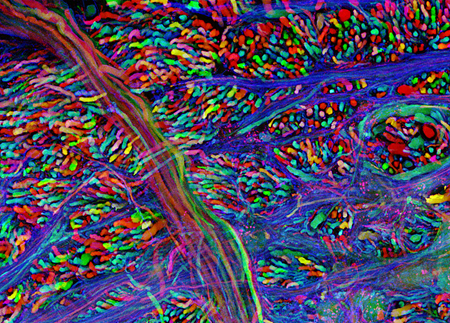
In the programme you will hear about the Brainbow Mouse. This Brainbow is a term used to describe the process by which individual neurons in the brain can be distinguished from neighboring neurons using fluorescent proteins. By randomly expressing different ratios of red (RFP), green (GFP), and blue (CFP=cyan fluorescent protein)  or Yellow (YFP) and Orange (OFP) derivatives of green fluorescent protein from jellyfish in individual neurons, it is possible to flag each neuron with a distinctive colour. 


This process has been a major contribution to the field of connectomics, or the study of neural connections in the brain. Brainbow (made up of 3 or 4 colours) has the capacity has the capacity to fluorescently label individual neurons with up to approximately 100 different hues so that scientists can identify aidiviudal nerve


This makes some amazing images

This will keep and army of people and loads of robots busy for some time. Wonder what would happen if the same sort resource was aimed at curing MS?

9 comments:

  1. If there were unlimited resources available, what do you think the impact on MS research would be?

    ReplyDelete
  2. I too would like to know how this project may help in MS research, especially in progressive MS.

    I saw this video on The Guardian website and wondered why this blog hadn't mentioned the Human Connectome Project before. Glad you have now and my thanks to the person who directed everyone to it. The bueaty of social networking.

    ReplyDelete
  3. "If there unlimited resources..would be".

    Much more progress.

    At present people are chasing a decreasing pot of research funding as things are more expensive to do...so many things bite the dust including focused and blue (pie in the)risky -sky research.

    Had there been unlimited resourses we would have known if CCSVI is the bees knees or it would be sunk without trace by now

    Does venoplasty do something else.

    I would have developed my version of a cure further, Prof G his, and others theirs, we would have been doing more about PPMS along time ago, repair may have been further alone the as a treatment possibility.

    Unfortunarely it is all just what ifs.

    ReplyDelete
  4. I wondered why the blog hadn't mentioned it before.
    There are lots of gems on the blog and if you read

    http://multiple-sclerosis-research.blogspot.co.uk/2012/03/research-brain-pathways.html

    The connectome protect has been already been mentioned.

    What will it tell us?

    In the short term it will tell us more about the potential consequences of lesions in MS and how this relates to symptoms on structure relationship. In the longer term it will help us understand how we may promote neural plasticity (http://multiple-sclerosis-research.blogspot.co.uk/2012/02/research-brain-plasticity.html) to get over some of the consequences of MS.

    But understanding the complexity of the brain is going to open so many new doors it is difficult to predict where it will lead.

    However, this is only the beginning, the first bit of the study will tell us the road map of connections, but knowing about the roads does not necessarility tell us the best way to get rid of gridlock.

    I suspect it will all be based on simple networks (see swa in the post above the nerves connect in cubes lattices)with simple on and offs input. But how the three dimensional network works in concert is going to difficult to dissect and will no doubt need alot of computational power to understand.

    There are excitatory and inhibitory and dis-inhbitory (inhibits and inhibitory pathway) and so excites) nerves so each of these elements have got to be put into the network

    Then there are many differnt transmittors that the nerves manke which adds to the complexity.

    Read the links and you will see the scientists vision of where it could lead.

    ReplyDelete
  5. Are peripheral nerve conduction studies of any use in MS? i.e. as MS is a central nervous system disorder will a peripheral nerve conduction study be of any help. I know it is useful in Guillaume Barre but this is obviously a condition that affects the peripheral nervous system

    ReplyDelete
  6. MouseDoctor, I underestimate you sometimes. You actually do know your stuff. You're clued up on the way the brain works in so many ways. Alas, I am so puzzeled when brainy dude like you and the Professor of G argue that even though you know so much about the brain and nervous system, it's still not enough to unriddle the complexities of MS.

    You'll figure it out one day, man. Kep at it and don't let all the noise get in your way. Power to you.

    ReplyDelete
  7. Dear Anon 2012

    No I know so little about the brain, I learn alot whilst reading about posts on the blog, this how I help justify spending the time.

    For my early life I knew very little about the brain and got wrapped in my immune bubble, which was the centre of my world, now it is not I have to learn neuroscience

    ReplyDelete
  8. Dear Anon 7.04
    Can periphral nerve conduction studies be of use,

    I would say proably for some aspects and proably not for others. A neuro could fill you in more.

    We have data that shows that some elements of MS symptomatology may be controlled outside the brain and spinal cord in perhieral nerves

    ReplyDelete
  9. Re: "Are peripheral nerve conduction studies of any use in MS?"

    In general nerve conduction studies are normal. However, there is a rare MS variant when the MSer presents with both central (brain and spinal cord) and peripheral nerve demyelination. The latter is called chronic inflammatory demyelinating polyneuropathy or CIDP. This is very rare and suggests that that the two conditions are probably unrelated and need to be treated on their individual merits.

    In late stage MS, for example when an MSer is in a wheelchair and they complain of new symptoms in their hands it is important to check the NCS to make sure they don't have a carpal tunnel syndrome or ulnar nerve entrapment at the elbow. Common things occurr commonly and MSers are not exempt from developing these other conditions.

    Therefore, NCS may or may not be important in MS. It takes an astute clinician to make the call on when to do them or not. He or she should not be doing them increase the size of the bill they charge for their services. Surprise, surprise this is not an uncommon phenomenon.

    ReplyDelete