
Did you know that alemtuzumab can rarely affect your looks? #ClinicSpeak #ResearchSpeak #MSBlog
There are two core messages in this post today.
- All alemtuzumabers (people who are treated with alemtuzumab) should know about Graves' eye disease
- The unpacking of biology continues at a rapid pace with a new treatment for Graves' eye disease
 |
| Graves' Ophthalmopathy; image from Wikipedia |
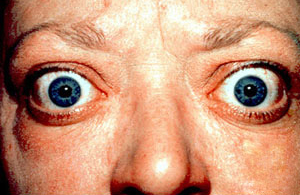
Why is this topic important? Graves' eye disease is one of the secondary autoimmune complications of Alemtuzumab treatment. I have now had two patients who have developed Graves' eye disease post-alemtuzumab. Both have said to me 'if I knew I was going to develop this complication I would never have had the treatment in the first place'. Why? It is cosmetically unattractive and one patient calls herself a a goldfish, because of her bulging eyes.
The good news is we now have a new treatment for treating Graves' eye disease. It is a monoclonal antibody called teprotumumab that blocks insulin-like growth factor I receptor (IGF-IR) one of the targets for the auto-antibodies. IGF-1 stimulates fat cells and by blocking this receptor the fat cells regress in the eye. This for me is beautiful science and shows how fast we are unpacking biology to develop treatments for diseases that were untreatable in the past.
I wonder how much this new treatment is going to cost? Add this on to what alemtuzumab already costs to treat MS and you begin to see why healthcare costs of treating MS and treating their complications are soaring.
Smith et al. Teprotumumab for Thyroid-Associated Ophthalmopathy. N Engl J Med. 2017 May 4;376(18):1748-1761.
BACKGROUND: Thyroid-associated ophthalmopathy, a condition commonly associated with Graves' disease, remains inadequately treated. Current medical therapies, which primarily consist of glucocorticoids, have limited efficacy and present safety concerns. Inhibition of the insulin-like growth factor I receptor (IGF-IR) is a new therapeutic strategy to attenuate the underlying autoimmune pathogenesis of ophthalmopathy.
METHODS: We conducted a multicenter, double-masked, randomized, placebo-controlled trial to determine the efficacy and safety of teprotumumab, a human monoclonal antibody inhibitor of IGF-IR, in patients with active, moderate-to-severe ophthalmopathy. A total of 88 patients were randomly assigned to receive placebo or active drug administered intravenously once every 3 weeks for a total of eight infusions. The primary end point was the response in the study eye. This response was defined as a reduction of 2 points or more in the Clinical Activity Score (scores range from 0 to 7, with a score of ≥3 indicating active thyroid-associated ophthalmopathy) and a reduction of 2 mm or more in proptosis at week 24. Secondary end points, measured as continuous variables, included proptosis, the Clinical Activity Score, and results on the Graves' ophthalmopathy-specific quality-of-life questionnaire. Adverse events were assessed.
RESULTS: In the intention-to-treat population, 29 of 42 patients who received teprotumumab (69%), as compared with 9 of 45 patients who received placebo (20%), had a response at week 24 (P<0.001). Therapeutic effects were rapid; at week 6, a total of 18 of 42 patients in the teprotumumab group (43%) and 2 of 45 patients in the placebo group (4%) had a response (P<0.001). Differences between the groups increased at subsequent time points. The only drug-related adverse event was hyperglycemia in patients with diabetes; this event was controlled by adjusting medication for diabetes.
CONCLUSIONS: In patients with active ophthalmopathy, teprotumumab was more effective than placebo in reducing proptosis and the Clinical Activity Score. (Funded by River Vision Development and others; ClinicalTrials.gov number, NCT01868997).
CoI: multiple